Condition Guide · Atlanta, GA
A deep, nagging ache on the side of the hip — worse lying on that side, worse on stairs, worse after sitting a long stretch — is one of the most commonly misread pains in the body. It is often not the joint and not bursitis alone, but the gluteal tendons where they attach to the hip bone, worn down and slow to heal.
In Their Words
A TenJet patient describes the procedure and the weeks that followed, without the clinical vocabulary.
TenJet Patient Testimonial
Video courtesy of HydroCision, Inc., the maker of TenJet®. Individual results vary; this patient's experience is not a guarantee of outcome. Talk with a specialist about whether the procedure is appropriate for you.
Understanding The Condition
The gluteus medius and minimus tendons anchor to a bony ridge on the outside of the hip. Under repeated load — or after a long stretch of inactivity followed by a sudden increase — that attachment point can develop the same kind of tissue breakdown seen in other stubborn tendons. It is often mislabeled as simple bursitis, which is one reason it can go months without the right treatment.
Where TenJet Fits
Load management, physical therapy, and sometimes an injection are the usual first steps, and many people turn the corner there. When the tendon stays painful, TenJet — a HydroCision, Inc. device — gives a specialist a way to treat the degenerated attachment directly, in the office, without the downtime of an open procedure.
See The Procedure
HydroCision's demonstration of the gluteal tendon procedure, plus a look at how a chronically degenerated tendon differs from one that is simply inflamed.
TenJet Gluteal Tendinopathy Minimally Invasive Tenotomy


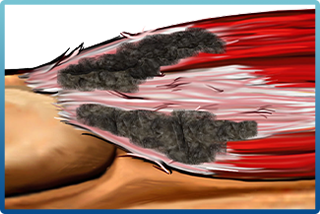
Diagrams and video courtesy of HydroCision, Inc.
Common Questions
Gluteal tendon pain can refer down the outside of the thigh, which resembles nerve pain. The distinguishing features are usually the tenderness pattern and what imaging shows.
Gluteal tendinopathy is more frequently diagnosed in women, particularly around and after menopause, though it occurs in men as well, especially in runners and manual workers.
Avoid positions that compress the tendon, such as crossing your legs or lying directly on the painful side, and note which activities reproduce the pain most reliably.
It is typically a single treatment session. Further intervention would only be considered after re-imaging and reassessment rather than as a scheduled course.
This information is general and is not medical advice. Whether any procedure is appropriate for you can only be determined by a physician who has examined you and reviewed your imaging.